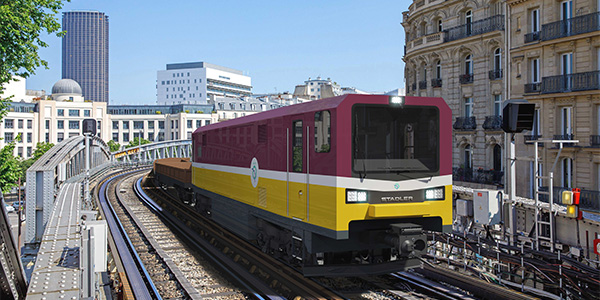
With millions of passengers riding the Paris Metro every day, extensive maintenance work takes place behind the scenes to keep the network running safely and reliably. Tracks, switches, and tunnels all require regular inspection, maintenance, and repair. To meet these needs, Stadler is building custom-designed maintenance locomotives for the Régie Autonome des Transports Parisiens (RATP), the operator of the Paris public transit system. At the heart of these vehicles is drive technology from Austria. In June 2025, Traktionssysteme Austria (TSA) received an order for 45 traction motors for four-axle maintenance locomotives, with the first deliveries scheduled for October 2026. The locomotives are expected to enter service in 2027 and operate across all 14 lines of the Paris Metro, which spans approximately 245 kilometers.
Battery-electric operation and third-rail power
One distinctive feature of the Stadler locomotives is their innovative power supply system. The vehicles have a combined battery-electric drive system, enabling them to operate using the 750-volt third rail during regular service. Additionally, they are also equipped with traction batteries that allow them to operate independently of the external power supply when needed.
This dual-power capability is particularly valuable during maintenance and construction work. When the third rail is de-energized in a work zone, the locomotives can switch to battery power and continue operating without relying on the external power supply. During regular operation, the batteries are recharged via the third rail. This flexibility allows the vehicles to operate both under normal conditions and in areas where power has been shut off to enable infrastructure work.
Proven motor platform for a new application
The TMF 42-38-4 motors form part of a motor family that TSA supplies in various configurations for rail vehicles and specialized applications. The forced-air-cooled motors deliver approximately 200 kW of power and weigh 580 kilograms. They feature redundant temperature sensors and hybrid bearings with ceramic rolling elements that can be relubricated.
“We are pleased to contribute our electric motors to this special project,” said Robert Tencl, CEO of TSA. “These locomotives are specifically designed to meet the demands of the Paris Metro and must perform reliably across a wide range of applications. Our motors play an important role in ensuring dependable drive performance.”
The first motors were delivered to Stadler in October 2026, marking the start of series production for TSA’s contribution to this specialized vehicle project, developed to meet the demanding requirements of a major urban rail network. The locomotives’ specifications reflect their dedicated role in maintenance operations. Each vehicle is approximately 15 meters long, has four axles, and is built for standard gauge track (1,435 millimeters). Operating individually, a locomotive can haul approximately 120 metric tons. For heavier work trains, two locomotives can be coupled to operate together, increasing the total hauling capacity to approximately 240 metric tons. Fully automatic couplers enable efficient connections to work trains, while the locomotives are designed to negotiate the tight curves found throughout the Paris Metro network. The combination of high tractive effort, the ability to operate in pairs, and access to all 14 Metro lines makes these locomotives a versatile solution for infrastructure maintenance.
Paris continues to expand its rail network
The contract for the new maintenance locomotives comes amid substantial investment in public transportation across Paris and the Île-de-France region. As the network expands, existing lines, stations, and technical systems are also undergoing extensive modernization. In 2026 alone, approximately €3.8 billion will be invested in renewing and modernizing the region’s public transit network, with a key focus on preparing the system for new vehicles and additional metro lines.
A central part of this effort is the Grand Paris Express, a major infrastructure project that will add four automated metro lines – 15, 16, 17, and 18 – with more than 200 kilometers of new track and 68 new stations across the Paris region. The expansion is expected to nearly double the size of the metro network. At the same time, improved connections between existing lines will help distribute passenger traffic more efficiently throughout the system.
For RATP, the parallel expansion and modernization of the network are driving demand for high-performance vehicles to support construction, service, and maintenance operations. Stadler’s new locomotives are purpose-built for these tasks and will provide essential support for the work required to maintain and upgrade Paris’s transit infrastructure. For TSA, the project demonstrates how its drive technology can be deployed in demanding rail applications around the world. Beyond supplying motors for a specific vehicle program, TSA is helping support the infrastructure maintenance needed to keep one of Europe’s major urban transit networks operating and evolving.